
PLEASE NOTE!
The Baptist Standard Bearer, Inc., will not be responsible for any books which are lost and/or damaged books when shipped through the USPS “Media Mail” shipping option. The Baptist Standard Bearer, Inc., will not reimburse customers if their orders are lost or damaged when shipped using this method. We have made this decision for two reasons: (1) USPS “Media Mail” shipping has become too erratic and careless in handling packages; and (2) USPS “Media Mail” shipping is non-insurable and not consistently dependable. For even though at the present time, the US Postal Service provides a “tracking number” for packages shipped through “Media Mail” this number cannot always be used for tracking packages to their ultimate destination. This “tracking number” often only goes to the primary USPS distribution center closest to the customer’s address but cannot be used for further tracking. Hence, The Baptist Standard Bearer, Inc., does NOT recommend the use of the USPS “Media Mail” shipping option and will not reimburse customers if their orders are lost or damaged when shipped using this method.

Home
Welcome
The Baptist Standard Bearer, Inc., is committed to the belief that Jesus Christ is the Son of God, the exalted Lord of all things. We believe His view of Holy Scripture determines the view of all those who profess Him as Saviour and Lord. Hence, our organization believes the Bible is the verbally inspired, inerrant and authoritative Word of God, the final rule of all Christian faith and practice. Even though we don’t recognize any creed or confession of faith as a final authority, our organization does distribute the Baptist Confessions of Faith of 1644 and 1677 (i.e., the 1st and 2nd London Confessions of Faith) as summarized statements of our basic doctrinal and practical beliefs.
The Baptist Standard Bearer, Inc., predominantly publishes material that focuses upon the identity, history and theology of the evangelical Baptist churches. Even though we also publish material not written by or about Baptists, we are primarily dedicated to republishing and preserving the works of Baptist authors which explain Baptist Beliefs and record Baptist Church History. This includes the writings of English and American Baptists, General and Particular Baptists, Northern and Southern Baptists, New School and Old School or Primitive Baptists. Consequently, we produce a series of books that set forth the primary Doctrines of the Baptist Faith and a series of books that expounds and defends the particular Baptist Distinctives.
While we publish a series of books dealing with the History of Baptist churches and Baptist principles, we also produce a series that details and records the history and theology of Dissent & Nonconformity since the time of the Apostles. This series includes books dealing with the Waldensians and the Anabaptists. The material in this series spans the pre-Reformation and post-Reformation eras leading up to and through the time of the Puritans, Separatists, Congregationalists and Pilgrims, showing the relationship of these various groups to the early English Baptists.
Read MoreNews
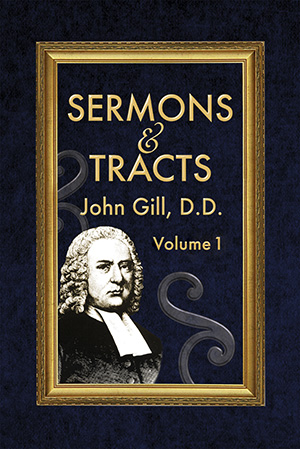
We are thankful to announce that Volume 1 of John Gill’s – Sermons & Tracts is now available. This is the first volume of our new seven-volume edition to be completed. This new set contains all the sermons, documents, and essays written by John Gill and previously published in the 1773 two-volume set, in the 1814 three-volume set, and several other sermons, etc., published individually and distributed as stand-alone documents. This new seven-volume set also contains several sermons and eulogies written by various writers which were published after John Gill’s death. There are approximately 3,500 pages in the set. Each volume contains its own Table of Contents and a Topical Index, wherein all the documents in the seven volumes are indexed by subject. If our research is correct, the publication of this seven-volume set will be the first time this material has been published simultaneously in one set. This seven-volume set does not include the other major writings of John Gill such as his Exposition of the Old & New Testament in nine volumes, nor his A Complete Body of Doctrinal & Practical Divinity, nor The Cause of God & Truth, nor An Exposition of Solomon’s Song. All of these have been previously published and are available on our Baptist Standard Bearer website.
All the material in this new set is complete and unabridged, but re-typeset in modern, easy-to-read fonts. Everything has been extensively proofread and all the Hebrew, Greek, and Latin words and phrases have been checked and compared for accuracy by teachers, editors, and professional linguists.
We believe the contents of this new set of John Gill’s – Sermons & Tracts will make a vital contribution toward a more accurate assessment and appreciation of John Gill and his writings because these can now be evaluated by each individual reader for himself, without the undue influence of either the friends or foes of John Gill. Most importantly, we believe the contents of this new set will exalt the LORD Jesus Christ, bring glory to God, and greatly comfort and encourage to the people of God.
Read MoreOur Perspective
ON BAPTIST IDENTITY
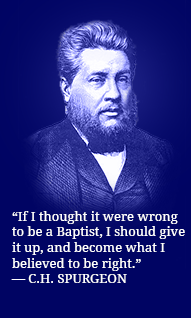
C. H. Spurgeon wrote, “If I thought it were wrong to be a Baptist, I should give it up, and become what I believed to be right.” C. H. Spurgeon’s Autobiography. (London: Passmore & Alabaster, 1897). Volume 1, Page 154. Again he said, “We are Baptists, and we cannot swerve from this matter of discipline.” Autobiography. Volume 2, Page 328. On another occasion he wrote, “We are Calvinistic Baptists, and have no desire to sail under false colors, neither are we ashamed of our principles; if we were, we would renounce them tomorrow.” The Metropolitan Tabernacle: Its History and Work. (London: Passmore & Alabaster, 1876). Page 4.
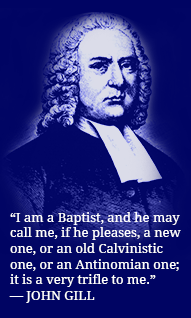
John Gill said, “I am a Baptist, and he may call me, if he pleases, a new one, or an old Calvinistic one, or an Antinomian one; it is a very trifle to me.” An Answer to the Birmingham Dialogue-Writer &c. – Part 1. (London: Aaron Ward, 1737). Page 134.
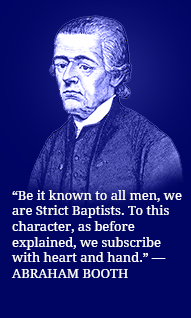
Abraham Booth wrote, “Our character is fixed. And be it known to all men, we are Strict Baptists. To this character, as before explained, we subscribe with heart and hand.” A Defense of the Baptists &c. (London: E. & C. Dilly, 1778). Page 142.
Read MoreWords of the Wise
THE INFINITY OF GOD
Great God! how infinite art Thou!
What worthless worms are we!
Let the whole race of creatures bow,
And pay their praise to Thee!
Thy throne eternal ages stood,
Ere seas or stars were made;
Thou art the ever-living God,
Were all the nations dead.
Nature and time quite naked lie
To Thy immense survey,
From the formation of the sky,
To the last great burning day.
Eternity, with all its years,
Stands present in Thy view;
To Thee there’s nothing old appears –
Great God! there’s nothing new!